Itamar J. Allali
Research
assets/img/defense.jpgAbout me
I am currently a Provost's Postdoctoral Society of Science Fellow at the University of Notre Dame. My work touches on areas including theoretical cosmology, cosmo-particle/astro-particle physics, high-energy/particle phenomenology, and gravity.
I received a B.S. in Specialized Physics and a B.S. in Astronomy from the University of Illinois at Urbana-Champaign in 2018. I then moved to Tufts university, earning an M.S. in Physics in 2020, and earning a Ph.D. in 2023 with my dissertation titled Axions in a Dark Universe: Dark Matter Behavior and Novel Dynamics Inform Cosmological Observations. Following my Ph.D., I was a postdoctoral research associate at Brown University from September 2023 to October 2025.
Research Interests
My interests include many topics in theoretical cosmology, high-energy theory/phenomenology, astro-particle physics, quantum physics, and gravity. What ties them together is the pursuit of a concordant picture of the universe: using cosmological and astrophysical observations to probe fundamental physics and uncover new particles and interactions. The Standard Model of particle physics and the ΛCDM model of cosmology are remarkably successful, yet neither explains the nature of dark matter (DM) and dark energy (DE), and many open questions remain about neutrinos. At the same time, as cosmological data grow more precise, tensions have emerged between different datasets that may be the first signs of new physics. With current and upcoming observatories such as JWST, DESI, Euclid, Rubin, and Roman, these questions are increasingly within observational reach.
A large part of my work centers on the dark components of the universe. DM makes up approximately 85% of the matter in the universe, yet what it is actually made of is still a complete unknown! I am interested in candidates for DM and how they behave, particularly axions and other light scalar fields. The QCD axion, originally proposed to solve the strong CP problem, is a well-motivated DM candidate, and I have studied both how it could make up the observed DM abundance and how its perturbations evolve in the early universe. I have also explored the quantum nature of light scalar DM, showing how gravitational interactions can allow macroscopic quantum behavior with consequences for direct detection.
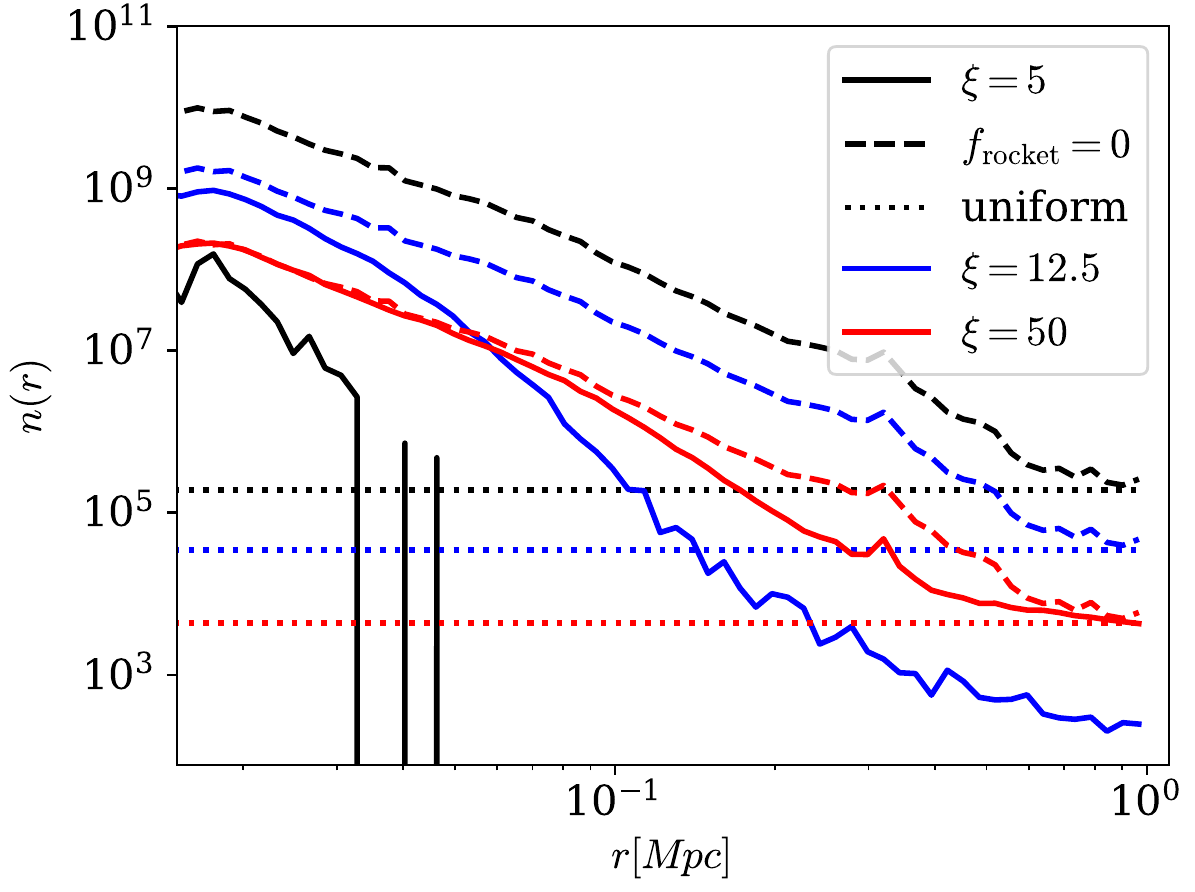
I am especially interested in using cosmic structures as a laboratory for new physics. Although DM halos and the galaxies they host form late in cosmic history, their abundance and structure are sensitive to physics from much earlier times, such as new particles during inflation or phase transitions in hidden sectors. Structure formation also determines where signatures of new physics reside today, such as how cosmic strings (topological defects predicted by many theories beyond the Standard Model) are gathered into forming galaxies. I approach these questions by combining analytical calculations with N-body simulations and, increasingly, machine learning, to test broad classes of theories against data as new observations arrive.
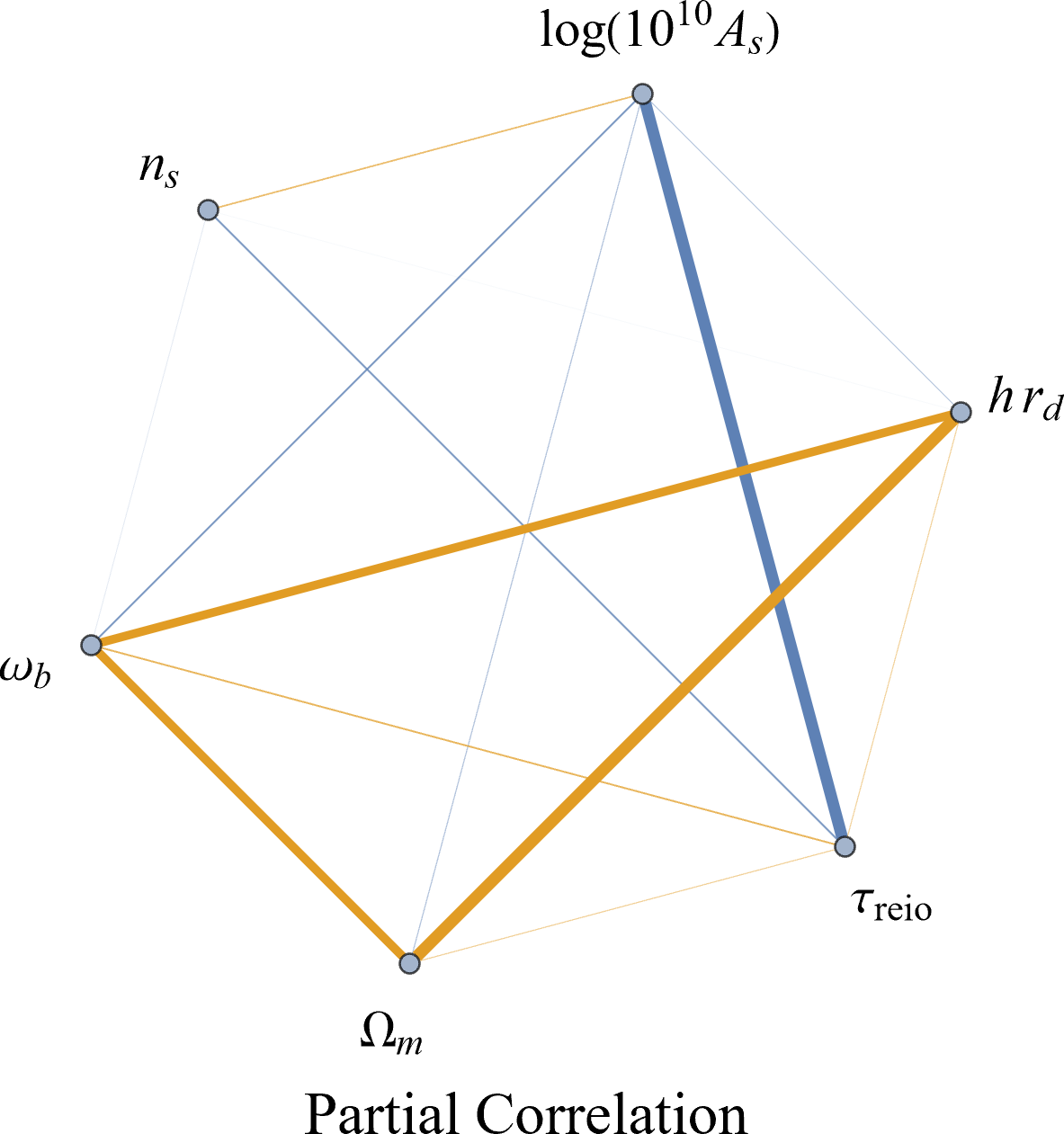
assets/img/plot-string-loops.pngAnother major direction of my work is the search for a cosmological concordance model. In recent years, the ΛCDM model has been challenged by a number of discrepant observations: bounds on the total mass of neutrinos from DESI that sit in tension with oscillation experiments; a preference for DE that is dynamical rather than constant in time; a discrepancy between the cosmic microwave background (CMB) and baryon acoustic oscillation (BAO) measurements of the matter abundance and expansion rate; and the Hubble tension, a disagreement between early- and late-universe measurements of the present expansion rate of the universe. I have built and tested models of new physics that could address these tensions, including dark sectors, dark radiation, and interacting neutrinos. More recently, I have developed an approach based on correlations: by quantifying how parameters and datasets relate to one another within a cosmological analysis, I can trace a tension to its direct drivers and identify which kinds of new physics could resolve it. For example, I found that many of these tensions correlate with the optical depth to reionization τ, but only indirectly, through a chain of relationships with other parameters. I am continuing to develop this approach, extending to new datasets and new applications while also exploring the use of AI tools to aid in such analyses.
assets/img/plot-correlations.pngBeyond what I have outlined above, I am always looking out for new ways to use cosmological and astrophysical observations to hunt for new physics phenomena. For example, the orbits of bound systems are sensitive to new forces and interactions, and I have used the orbital dynamics of the Juno spacecraft around Jupiter to constrain new long-range forces. More broadly, I am always open to new directions wherever cosmology, particle physics, and gravity meet.
More
You can find a summary of my publications and talks here,
or a summary of my teaching experience here.